
|
|
(Our navigation buttons are at the TOP of each screen.)Cramér-Rao Lower Bound (CRLB) Analysis & EvaluationKey Benefits:
Capabilities:
An interesting result due to A. J. Stam [24,
1959] is the derivation of Weyl-Heisenberg uncertainty principle in physics
using a specific version of the CRB. Further applications in physics of CRB and
Fisher information as a concept underlying the well-known physical theories can
be found in the book by B. Roy Frieden, “Physics from Fisher Information”
[25]. Historical Account of our experience therein:[1] Kerr, T. H., “A New Multivariate Cramer-Rao Inequality for Parameter Estimation (Application: Input Probing Function Specification),” Proceedings of IEEE Conference on Decision and Control, Phoenix, AZ, pp. 97-103, Dec. 1974.[2] Kerr, T. H., “Status of CR-Like Lower bounds for Nonlinear Filtering,” IEEE Transactions on Aerospace and Electronic Systems, Vol. 25, No. 5, pp. 590-601, Sept. 1989 (Author’s reply in Vol. 26, No. 5, pp. 896-898, Sept. 1990). [3] Kerr, T. H., “Cramér-Rao Lower Bound Implementation and Analysis for NMD Radar Target Tracking,” TeK Associates Technical Report No. 97-101 (for MITRE), Lexington, MA, 26-30 Oct. 1997. [4] Kerr, T. H., “NMD White Paper on Designated Action Item,” MITRE, Bedford, MA, Jan. 1998. [5] Kerr, T. H., “Cramér-Rao Lower Bound Implementation and Analysis: CRLB Target Tracking Evaluation Methodology for NMD Radars,” MITRE Technical Report, Contract No. F19628-94-C-0001, Project No. 03984000-N0, Bedford, MA, Feb. 1998. [6] Kerr, T. H., “Developing Cramér-Rao Lower Bounds to Gauge the Effectiveness of UEWR Target Tracking Filters,” Proceedings of AIAA\BMDO Technology Readiness Conference and Exhibit, Colorado Springs, CO, 3-7 Aug. 1998 (Unclassified). The Government Furnished Data (GFD) that we were provided with and that we used as inputs in the evaluations was incorrect in this document (so our output results were also incorrect as a direct consequence) . The corrected GFD was provided by Dan Polito and appears in the document [7] below (which we stand by). [7] Kerr, T. H., UEWR Design Notebook-Section 2.3: Track Analysis, TeK Associates, Lexington, MA, (for XonTech, Hartwell Rd, Lexington, MA), XonTech Report No. D744-10300, 29 Mar. 1999. [8] Kerr, T. H., “A Critical View of Some New and Older approaches to EWR Target Tracking: A Summary and Endorsement of Kalman Filter-Related Techniques,” a tutorial submitted to IEEE Aerospace and Electronic Systems, (yet to be submitted). [9] Hue, C., Le Cadre, J.-P., Perez, P., “Posterior Cramér-Rao Bounds for Multi-Target Tracking,” IEEE Trans. on Aerospace and Electronic Systems, Vol. 42, No. 1, pp. 37-49, January 2006. [10] Gault, S., Hachem, W., Ciblat, P., “Joint Sampling Clock Offset and Channel Estimation for OFDM Signals: Cramér-Rao Bound and Algorithm,” IEEE Trans. on Signal Processing, Vol. 54, No. 5, pp. 1875-1885, May 2006. [11] Yetik, I. S., Nehorai, A., “Performance Bounds on Image Registration,” IEEE Trans. on Signal Processing, Vol. 54, No. 5, pp. 1737-1749, May 2006. [12] Zou, Q., Lin, Z., Ober, R. J., “The Cramér-Rao Lower Bound for Bilinear Systems,” IEEE Trans. on Signal Processing, Vol. 54, No. 5, pp. 1666-1680, May 2006. [13] Eldar, Y., “Uniformly Improving the Cramér-Rao Bound and Maximum-Likelihood Estimation,” IEEE Trans. on Signal Processing, Vol. 54, No. 8, pp. 2943-2956, Aug. 2006. [14] Brehard, T., Le Cadre, J.-P., “Closed-Form Posterior Cramér-Rao Bounds for Bearings-Only Tracking,” IEEE Trans. on Aerospace and Electronic Systems, Vol. 42, No. 4, pp. 1198-1223, Oct. 2006. [15] Au-Yueng, C. K., Wong, K. T., “CRB: Sinusoid-Sources' Estimation using Collocated Dipoles/Loops,” IEEE Trans. on Aerospace and Electronic Systems, Vol. 45, No. 1, pp. 94-109, Jan. 2009. [16] Kay, S., Xu, C., “CRLB via the Characteristic Function with Application to the K-Distribution,” IEEE Trans. on Aerospace and Electronic Systems, Vol. 44, No. 3, pp. 1161-1168, Jul. 2008. [17] Smith, S. T., “Statistical Resolution Limits and the Complexified Cramér-Rao Bound,” IEEE Trans. on Signal Processing, Vol. 53, No. 5, pp. 1597-1609, May 2005. [18] Smith, S. T., “Covariance, Subspace, and Intrinsic Cramér-Rao Bounds,” IEEE Trans. on Signal Processing, Vol. 53, No. 5, pp. 1610-1630, May 2005. [19] Gini, F., Regianini, R., Mengali, U., “The Modified Cramér-Rao Lower Bound in Vector Parameter Estimation,” IEEE Trans. on Signal Processing, Vol. 46, No. 1, pp. 52-60, Jan. 1998. [20] Buzzi, S., Lops, M., Sardellitti, S., “Further Results on Cramér-Rao Bounds for Parameter Estimation in Long-Code DS/CDMA Systems,” IEEE Trans. on Signal Processing, Vol. 53, No. 3, pp. 1216- 1221, Mar. 2005. [22] Boers, Y., Driessen, H., “A Note on Bounds for Target Tracking with Pd < 1,” IEEE Trans. on Aerospace and Electronic Systems, Vol. 45, No. 2, pp. 640-646, Apr. 2009. [23] Bobrovsky, Wolf, and Zakai, Annals of Statistics, Vol. 15, pp. 1421-1438, 1987. [25] Frieden, B. Roy, Physics from Fisher
Information, Cambridge University Press, 1998. [26] Brody, D. C. and Hughston, L. P., Proceedings of the Royal Society, Vol. 454, pp. 2445-2475, 1998. [27] Wolf, E. Mayor, Annals of Probability, Vol. 18, pp. 840-850, 1990. [28] http://www.aiaccess.net/English/Glossaries/GlosMod/e_gm_cramer_rao.htm [29] http://www.scholarpedia.org/article/Cramér-Rao_bound [30] http://www.dauwels.com/Papers/BCRB.pdf [31] I. Rapoport and Y. Oshman, “A Cramér-Rao-type estimation lower bound for systems with measurement faults,” IEEE Transactions on Aerospace and Electronic Systems, Vol. 50, No. 9, pp. 1234–1245, Sept. 2005. [32] R. M. Taylor, Jr., B. P. Flanagan, and J. A. Uber, “Computing the recursive posterior
Cramér-Rao bound for a nonlinear nonstationary system,” in
IEEE International Conference on Acoustics, Speech, and Signal Processeing (ICASSP),
Vol. 6, pp. 673–676, Apr. 2003. [40] F. E. Daum, “Bounds on performance for multiple target tracking,” IEEE Transactions on Automatic Control, Vol. 35, No. 4, pp. 443–446, Apr. 1990. [41] F. E. Daum, “A Cramér-Rao bound for multiple target tracking,” in
Proceedings of SPIE, Signal and Data Processing of Small Targets, Vol. 1481, Orlando,
FL, pp. 341–343, Apr. 1991. [43] M. L. Hernandez, A. D. Marrs, N. J. Gordon, S. R. Maskell, and C. M. Reed, “Cramér-Rao bounds for non-linear filtering with measurement origin uncertainty,” in Proceedings of the 5th International Conference on Information Fusion, Vol. 1, pp. 18–25, Jul. 2002. [44] X. Zhang, P. Willett, and Y. Bar-Shalom, “Dynamic Cramér-Rao bound for target tracking in clutter,” IEEE Transactions on Aerospace and Electronic Systems, Vol. 41, No. 5, pp. 1154–1167, Oct. 2005. [45] N. Bergman, “Recursive Bayesian estimation: Navigation and tracking applications,” Ph.D. dissertation, Linkoping University, SE-581 83 Linkoping, Sweden, April 1999. [46] N. Bergman, Sequential Monte Carlo Methods in Practice, New York: Springer, New York, 2001 (Chapter: Posterior Cramér-Rao Bounds for Sequential Estimation, pp. 321–338). [47] Justin Dauwels, “Computing Bayesian
Cramer-Rao bounds," http://www.dauwels.com/Papers/BCRB.pdf [48] Justin Dauwels, Sascha,
Korl, “A Numerical Method to Compute Cramer-Rao-Type Bounds for Challenging Estimation
Problems,” [49] CORE https://core.ac.uk/display/23680005 (several different papers coauthored by others, as, perhaps, offshoots) [50] Frank R. Kschischang , Brendan J. Frey , Hans-Andrea
Loeliger, “Factor Graphs and the Sum-Product Algorithm,” IEEE Transactions on Information
Theory, 1998. How to Handle Jamming Considerations: [52] Myers, L., Improved Radio Jamming Techniques: Electronic Guerilla Warfare, ISBN 0873645200, Paladin Press, Boulder, CO, 1989. [53] Chapter 8 of Bar-Shalom, Y., Blair, W. D., (Eds.), Multitarget-Multisensor Tracking Applications and Advances, Vol. III, Artech House Inc., Boston, MA, 2000. [54] Daum F. E., "Cramér-Rao Type Bounds for Random Set Problems," in
Random Sets Theory and Applications, Editors: John Goutsias, Ronald P. S.
Mahler, Hung T. Nguyen, The IMA Volumes in Mathematics and its Applications book series
(IMA, Volume 97), pp. 165-183, 2006.
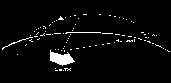
Gaussian Confidence Region or uncertainty ellipsoid (associated with target tracking) goes from “being a pancake” (at the horizon) to “being a football” (after sufficient radar returns have accrued). When knowledge of target’s trajectory is sufficiently accurate, then the target can be successfully intercepted.
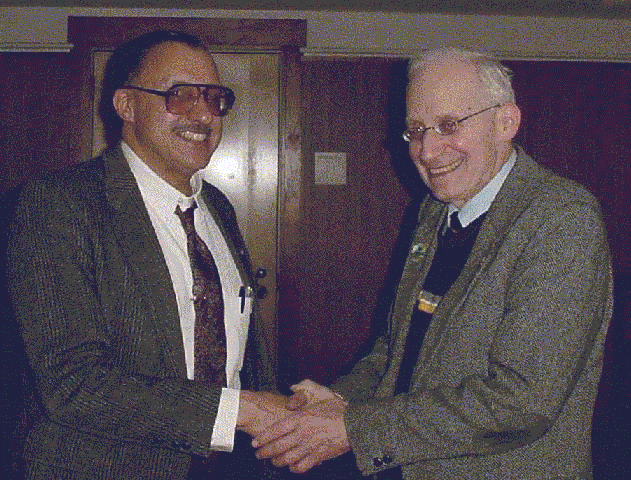
Tom Kerr and Dr.Eli Brookner http://www.ieee.org/about/awards/bios/picard_recipients.html
|
|
TeK Associates motto: "We work hard to make your job easier!" |