|
|
|
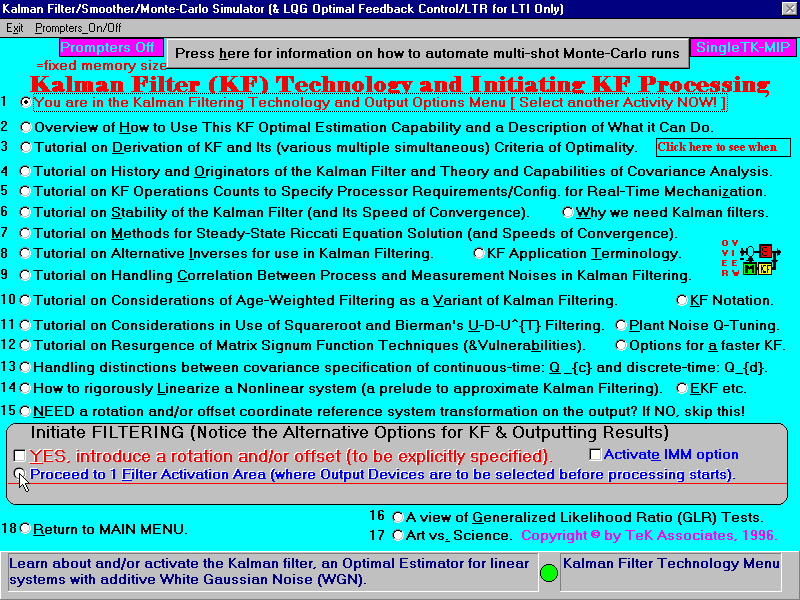
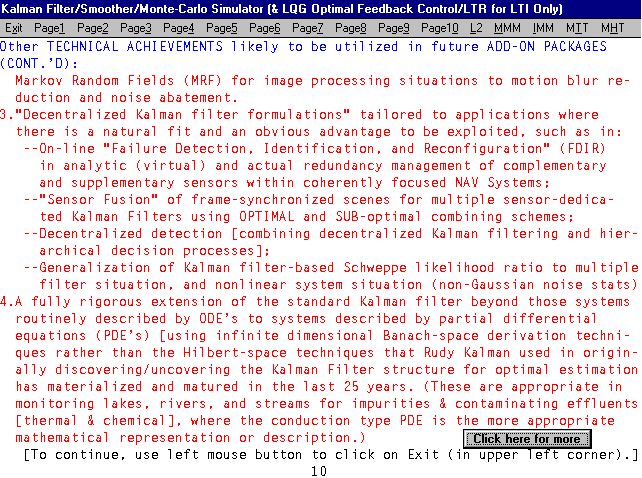
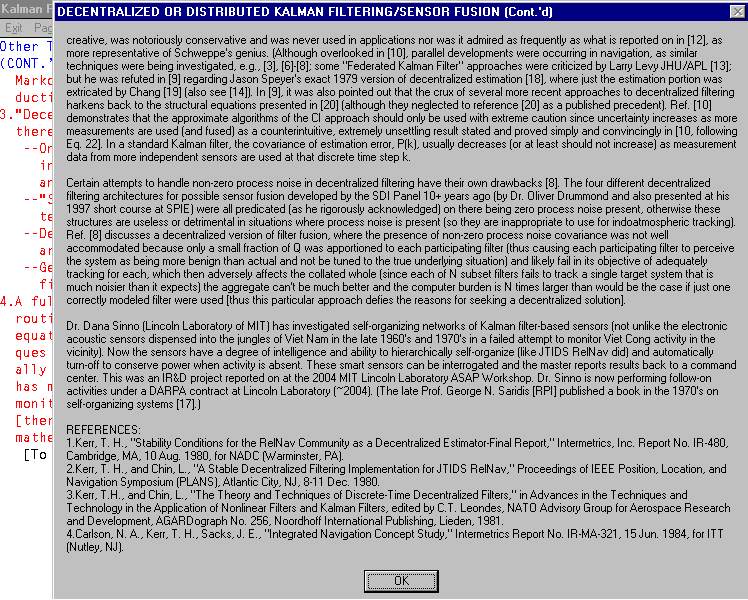
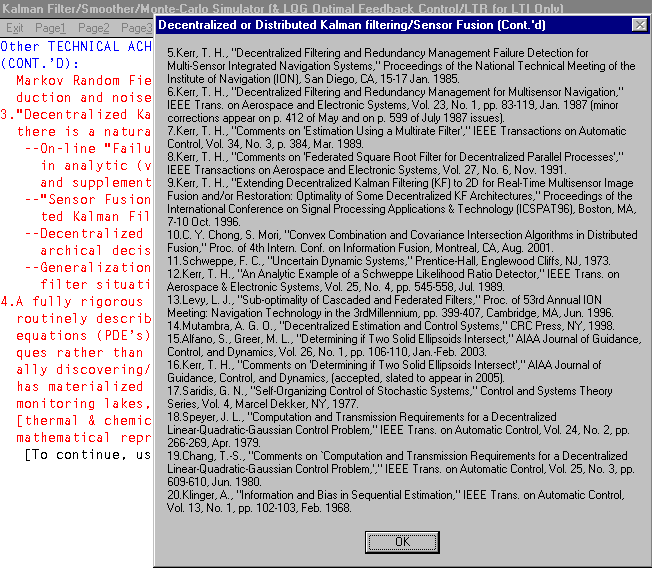
Screen Shot #4 (Merely a picture to illustrate that our GUI is totally self-explanatory)
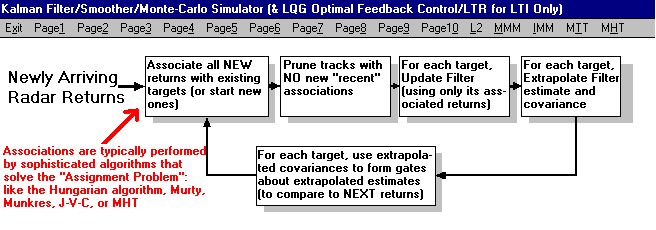
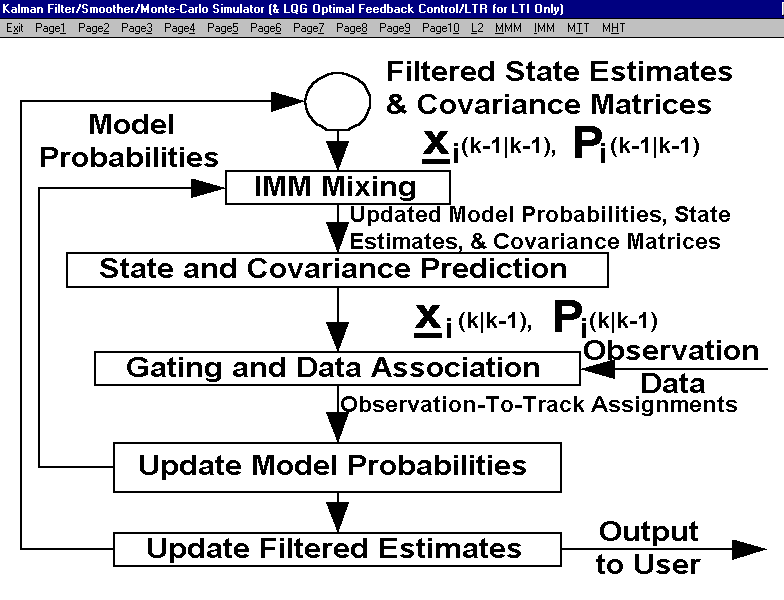
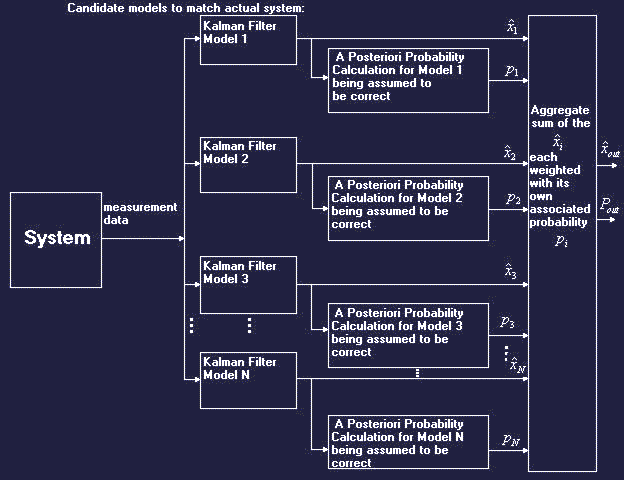
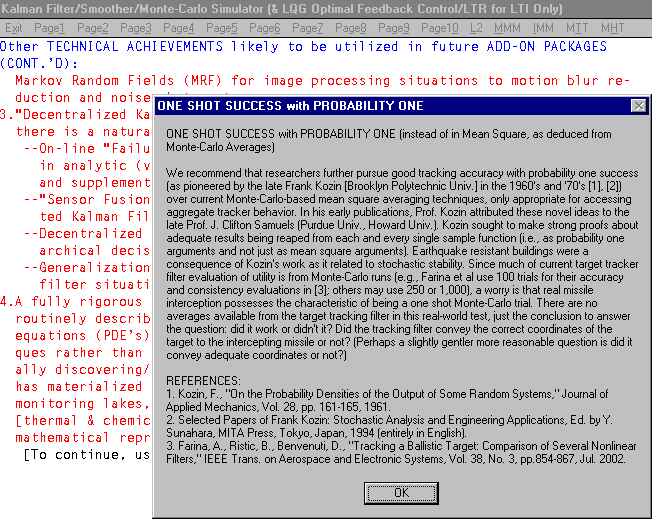
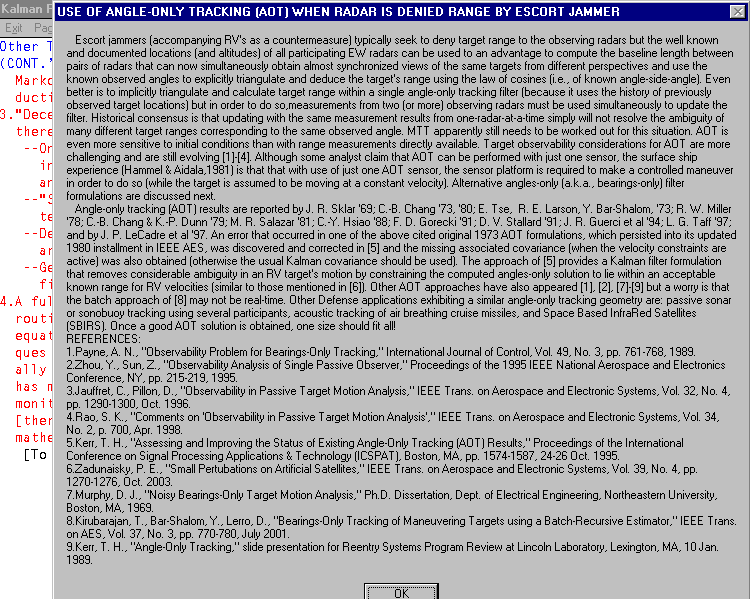
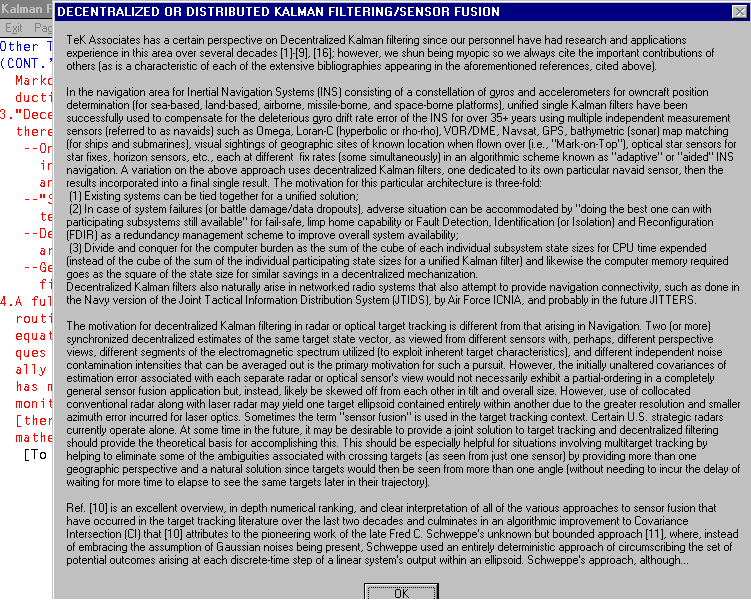
The essence of how to handle multi-target tracking using Kalman filters (via radar, sonar, other acoustic, or infrared) is conveyed in the following two screens:
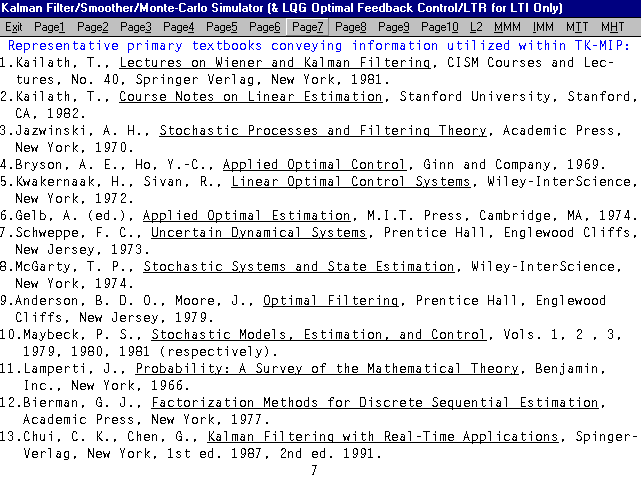
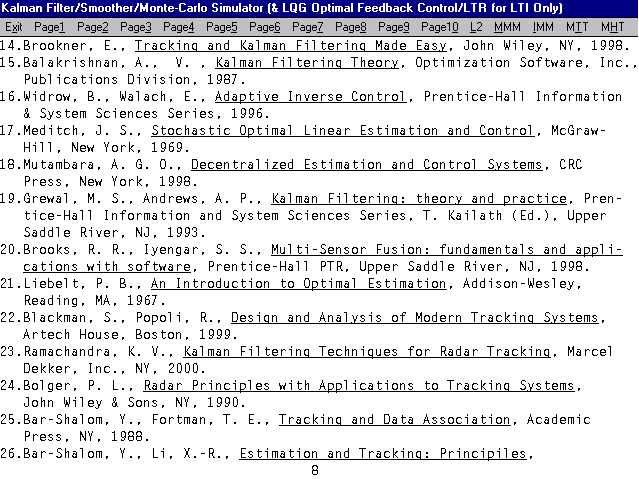
Also see Miller, M. L., Stone, H, S., Cox, I. J., “Optimizing Murty’s Ranked Assignment Method,” IEEE Trans. on Aerospace and Electronic Systems, Vol. 33, No. 7, pp. 851-862, July 1997. Another: Frankel, L., and Feder, M., “Recursive Expectation-Maximizing (EM) Algorithms for Time-Varying Parameters with Applications to Multi-target Tracking,” IEEE Trans. on Signal Processing, Vol. 47, No. 2, pp. 306-320, February 1999. Yet another: Buzzi, S., Lops, M., Venturino, L., Ferri, M., “Track-before-Detect Procedures in a Multi-Target Environment,” IEEE Trans. on Aerospace and Electronic Systems, Vol. 44, No. 3, pp. 1135-1150, July 2008.
Comment: Dr. Eli Brookner's (Raytheon-retired) book, listed as #14 above, provides its very nice Chapter 3 that is especially helpful in handling the important Kalman filter applications to radar. He not only provides state-of-the-art but also filter state selection designs that were historically relied upon when computer capabilities were more restricted than today and designers were forced to simplify and rely on mere alpha-beta filters (corresponding to position and assumed constant velocity in a Kalman filter in as many dimensions as are actually being considered by the associated radar application: 2-D or 3-D), or on mere alpha-beta-gamma filters (corresponding to position and velocity and assumed constant acceleration in a Kalman filter in as many dimensions as are actually being considered by the associated radar application: 2-D or 3-D). Other historical conventions such as g-h filters or g-h-k filters and common variations such as that of "Benedict-Bordner" are also explained along with their appropriate track initiation. The relation between Kalman filters and Weiner Filters is also addressed, similar to what was provided in Gelb, Arthur (ed.), Applied Optimal Estimation, MIT Press, Cambridge, MA, 1974. http://users.isr.ist.utl.pt/~pjcro/temp/Applied%20Optimal%20Estimation%20-%20Gelb.pdf
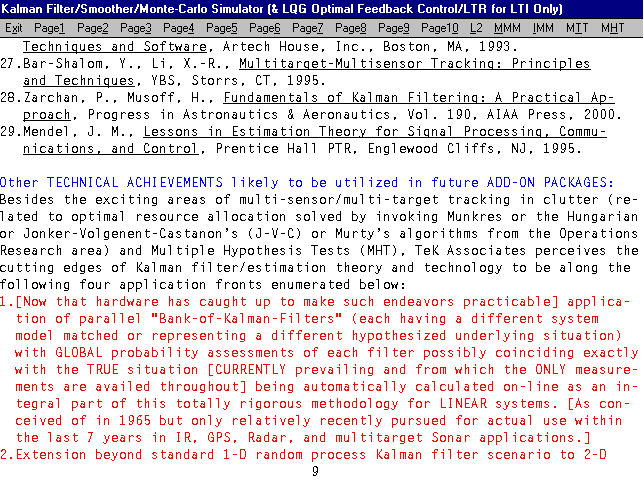
Also #30 as an addendum to the above list: Candy, J. V., Model-Based Signal Processing, Simon Haykin (Editor), IEEE Press and Wiley-Interscience, A John Wiley & Sons, Inc. Publication, Hoboken, NJ, 2006. Also #31 as an addendum to the above list: Bruce P. Gibbs, ADVANCED KALMAN FILTERING, LEAST-SQUARES AND MODELING: A Practical Handbook, John Wiley & Sons, Inc., Hoboken, New Jersey, 2011.
Also see: Rao, S. K., “Comments on Discrete-Time Observability and Estimability Analysis for Bearings-Only Target Motion Analysis,” IEEE Trans. on Aerospace and Electronic Systems, Vol. 34, No. 4, pp. 1361-1367, Oct. 1998.
Candy, J. V., Model-Based Signal Processing, Simon Haykin (Editor), IEEE Press and Wiley-Interscience, A John Wiley & Sons, Inc. Publication, Hoboken, NJ, 2006. [This new book, by an author with a Lawrence Livermore National Laboratory/University of California, Santa Barbara affiliation, offers a reasonably wide modern coverage and good pointers to precedents just like our own TeK Associates’ TK-MIP also offers but our software costs only $499 and their software cost more than three times as much and apparently does much less (and requires the use of MatLab, which is a considerable expense in itself)]. Gupta, S. N., “An Extension of Closed-Form Solutions of Target-Tracking Filters with Discrete Measurements,” IEEE Trans. on Aerospace and Electronic Systems, Vol. 20, No. 6, pp. 839-840, Nov. 1984. The best discussion of the proper sequence of discrete-time KF operations (to be implemented into software) that I have encountered to date is found on pages 234-236 of: |
|
TeK Associates motto: "We work hard to make your job easier!" |